> ## Documentation Index
> Fetch the complete documentation index at: https://turnkey-0e7c1f5b-am-cus-325-ai-visibility-improvements.mintlify.site/llms.txt
> Use this file to discover all available pages before exploring further.
> ## Agent Instructions
> Turnkey is wallet infrastructure: create and manage crypto wallets, sign transactions, and enforce policy-based access controls. Best-fit uses: embedded consumer wallets (email/passkey/social auth, no seed phrases), automated onchain operations with server-side wallets, AI agent wallets with policy-scoped signing, enterprise key management, and verifiable off-chain workloads on Turnkey Verifiable Cloud (TVC).
> Every API call is a JSON POST to https://api.turnkey.com signed with a P-256 API key; create an organization and key self-serve at https://app.turnkey.com.
> Key Turnkey developer resources: API reference (https://docs.turnkey.com/api-reference/overview/intro.md), OpenAPI spec (https://docs.turnkey.com/public_api.swagger.json), authentication (https://docs.turnkey.com/features/authentication/overview.md), webhooks (https://docs.turnkey.com/features/webhooks/overview.md), MCP server for docs search (https://docs.turnkey.com/mcp), agent skills (https://docs.turnkey.com/get-started/ai-skills.md), CLI (https://docs.turnkey.com/sdks/cli.md), SDK reference (https://docs.turnkey.com/sdks/introduction.md), full docs content (https://docs.turnkey.com/llms-full.txt).
# Secure enclaves
A core security anchor at Turnkey is the ability to prove to ourselves and our users that all systems within secure enclaves are running exactly the software we expect at any given time. To accomplish this, all security-critical Turnkey services—including key generation, signing, and our policy engine—are deployed in secure enclaves.
Secure enclaves, also called Trusted Execution Environments, are highly constrained compute environments that support cryptographic attestation to verify the enclave's identity and ensure that only authorized code is running. These enclaves operate in hardware-enforced isolation –– they have no persistent storage, no interactive access, and no external networking.
The following outlines the structure of a single enclave application:
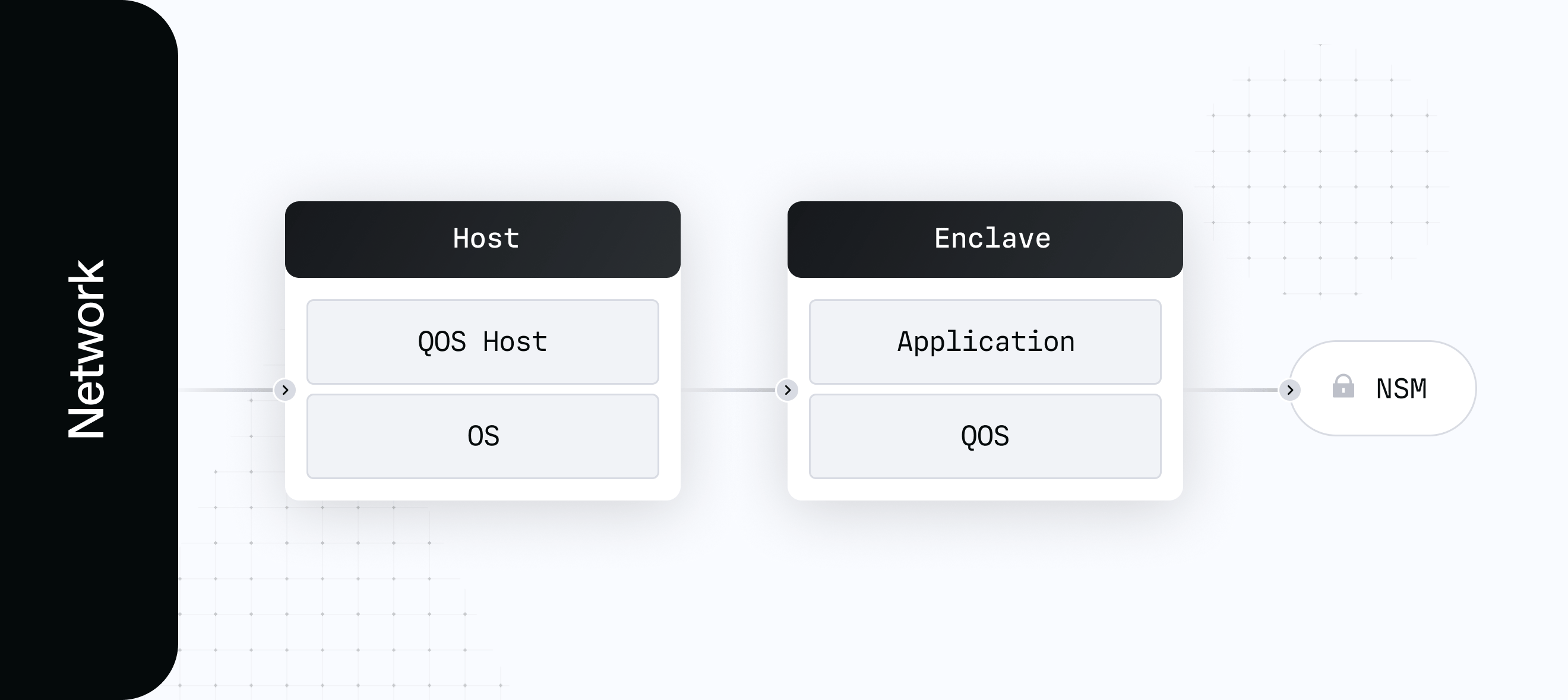 In this diagram *Host* represents a standard AWS virtual machine. We run a basic application that receives traffic from the network and calls into the enclave. This creates a layer of insulation from our most secure environment and offers a convenient place to gather metrics and other operational information about the enclaves.
*Enclave* represents a machine with no external connectivity. The only connection it can have is a virtual serial connection to the host and its own secure co-processor. In AWS this is called the Nitro Security Module (NSM). This runs an instance of Turnkey's enclave operating system, QuorumOS (QOS), and a secure application running on top of QOS.
In this diagram *Host* represents a standard AWS virtual machine. We run a basic application that receives traffic from the network and calls into the enclave. This creates a layer of insulation from our most secure environment and offers a convenient place to gather metrics and other operational information about the enclaves.
*Enclave* represents a machine with no external connectivity. The only connection it can have is a virtual serial connection to the host and its own secure co-processor. In AWS this is called the Nitro Security Module (NSM). This runs an instance of Turnkey's enclave operating system, QuorumOS (QOS), and a secure application running on top of QOS.